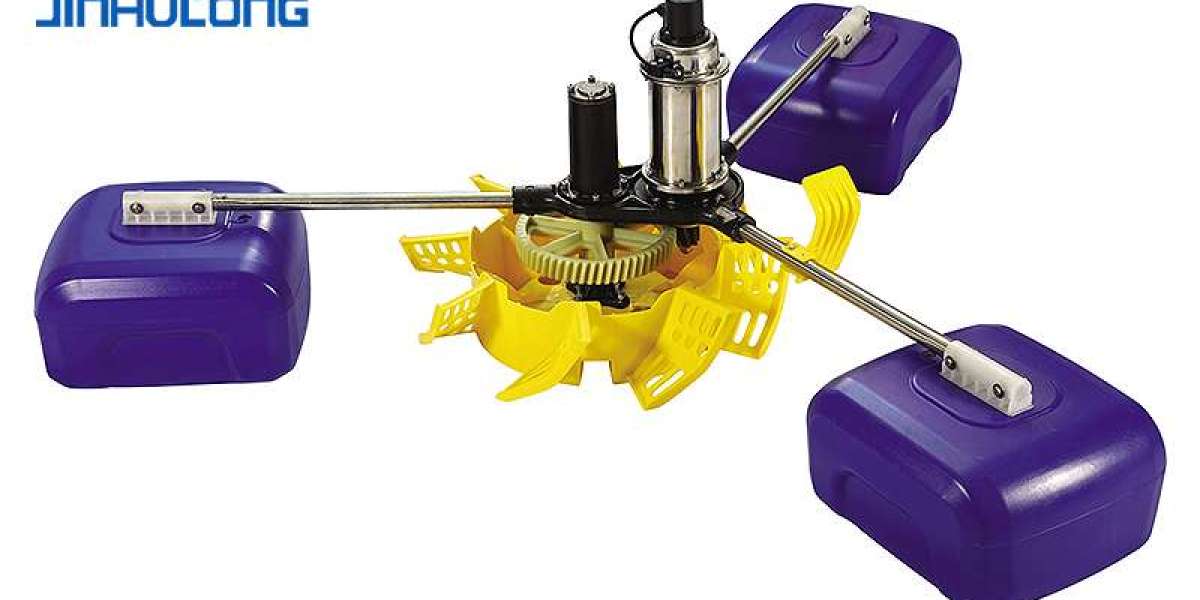

An Impeller Aerator generates bubbles through high-speed mechanical rotation, simultaneously agitating water and drawing air into the flow. When the impeller spins, it creates a low-pressure zone that pulls atmospheric air downward into the water column. This air is instantly fragmented by the strong shear forces around the rotating blades, forming a large volume of fine to medium bubbles. Because air intake and bubble formation occur simultaneously with water circulation, oxygen transfer begins immediately after bubbles are formed.
How Does Impeller Motion Enhance Air–Water Contact?
The rotating impeller does more than just inject air; it violently mixes air and water in three dimensions. This turbulence keeps bubbles suspended longer instead of letting them rise quickly to the surface. The extended residence time increases the contact area between oxygen and water, which directly improves oxygen dissolution. Continuous circulation also ensures that newly oxygenated water is evenly distributed, preventing localized high-oxygen zones and stagnant low-oxygen areas.
Why Are Bubble Size and Distribution Critical to Efficiency?
Aeration efficiency depends heavily on bubble surface area rather than bubble volume. The impeller’s shear forces break incoming air into smaller bubbles compared with many conventional systems. Smaller bubbles provide a much higher total surface area, allowing more oxygen molecules to transfer into the water before the bubbles escape. At the same time, the impeller spreads bubbles horizontally and vertically, maximizing oxygen exposure across the entire water body instead of concentrating it near a single outlet.
Why Is This Method More Efficient Than Ordinary Aeration?
Traditional aeration methods often rely on passive diffusion or limited airflow, where air rises quickly and escapes before sufficient oxygen transfer occurs. In contrast, an Impeller Aerator integrates air intake, bubble fragmentation, and forced circulation into one continuous process. This integration reduces oxygen loss, improves mixing depth, and delivers faster results with the same or even lower energy input. The system’s mechanical action ensures that oxygen transfer is not dependent solely on buoyancy, which is a major limitation of ordinary systems.
How Does Active Circulation Improve Overall Oxygen Utilization?
Beyond bubble generation, strong water circulation plays a decisive role in efficiency. The impeller pushes oxygen-rich water outward and pulls oxygen-depleted water back toward the mixing zone. This constant exchange accelerates oxygen equalization throughout the water body. As a result, oxygen demand is met more quickly, biological activity stabilizes faster, and overall aeration performance remains consistent even under high organic or stocking loads.
What Makes This Technology Suitable for High-Demand Applications?
Because it combines fine bubble production with aggressive mixing, this aeration approach performs reliably in environments where oxygen demand fluctuates or peaks suddenly. The ability to rapidly dissolve oxygen and distribute it evenly makes the system more efficient than ordinary aeration in both short-term oxygen recovery and long-term water quality management.